AI Automation Services
AI Automation for Marketing Workflows
Lead capture, CRM hygiene, follow-up, reporting, content repurposing, ad creative and the social inbox — the marketing work between your tools, rebuilt so it runs without anyone doing it by hand, inside the stack and the team you already have.
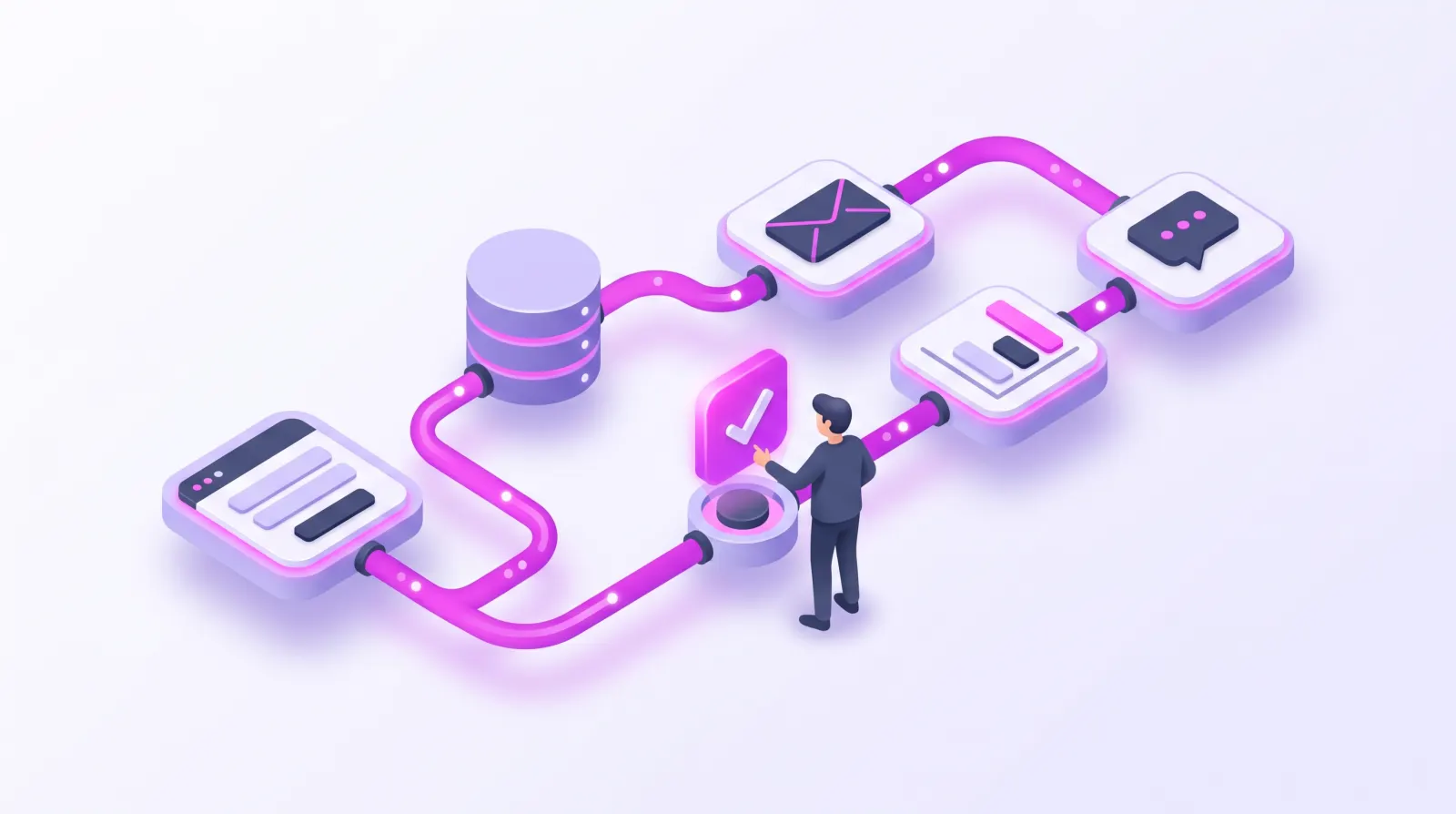
A marketing workflow, running
One lead, from the form to a person
In the minute it arrives, three in the morning included. The software does the reading, the scoring and the filing; the conversation stays with your team.
A lead arrives
Form submitted
Read and enriched
The software reads it
Scored
Against your criteria
Filed and routed
CRM record, reasoning attached
A person takes over
Every real conversation
What is AI automation?
AI automation is the practice of handing a repeatable business process to software that can read, write and decide, rather than only follow fixed rules. In marketing it means the steps between systems — qualifying a lead, updating a record, drafting a follow-up, assembling a report — run on their own, while people keep direction and judgement.
The distinction that matters is between automation and a rule. A rule can move a form submission into a spreadsheet. It cannot read the submission, work out that the company behind it is too small for a sales call, write a reply that says so politely, and file the record with the reason attached. That second job is what the word now covers, and it is why workflows that were left manual for years are suddenly worth revisiting.
It is also why the honest scope is narrower than the marketing around it. AI automation is very good at the steps nobody wants to do and everybody already agrees on. It is poor at the steps where the disagreement is the point.
A rule
- Form submitted
- Row added to a spreadsheet
Moves the submission. Cannot read it.
AI automation
- Form submitted
- Reads it
- Works out the fit
- Writes the reply
- Files the record with the reason
Reads, decides and writes, then leaves the reasoning attached to the record.
What an AI automation agency does, and what happens here instead
Search for AI automation services and most of what comes back is one of two things. The first is an AI automation agency that will run the workflows for you: it builds in its own accounts, keeps the wiring on its side, and bills monthly for the arrangement. The second is a platform — somewhere to draw the workflow yourself, once you have worked out what the workflow should be.
The work described on this page is a third thing. The workflows are built inside your accounts, on tools you already pay for, documented, and handed to a named owner on your team. If the engagement ends, the automation keeps running and your people can change it. That is the rule every engagement on this site follows: the capability stays with the company rather than with whoever installed it.
It is also deliberately separate from the AI marketing team. That is a staffing model — agents standing in for the execution roles a growing department would otherwise hire for. This is a workflow model: the team stays the size it is, and the work between them stops being done by hand. Companies that want both usually start here, because a workflow nobody has written down cannot be automated and cannot be handed to an agent either.
An AI automation agency
- Where it is built
- In the agency's own accounts
- Who holds the wiring
- The agency keeps it on its side
- What that means
- It bills monthly for the arrangement
A platform
- Where it is built
- On a canvas you draw yourself
- Who holds the wiring
- You, once you have worked out the workflow
- What that means
- You still have to work out what the workflow should be
What happens here
- Where it is built
- Inside your accounts, on tools you already pay for
- Who holds the wiring
- A named owner on your team, with documentation
- What that means
- If the engagement ends, it keeps running and your people can change it
Seven marketing workflows worth automating
These are the ones that come up most often in a marketing function that is already working. Each is described the same way: what it looks like now, what it looks like after, what the software actually does, and where a person stays in the loop.
- 01
Lead capture and qualification
Before
A form fires an email into a shared inbox. Someone opens it between other tasks, decides whether it is worth a reply, copies the details into the CRM if they remember, and anything that arrives on a Friday afternoon waits until Monday.
After
The submission is enriched, scored against the criteria the business actually uses, routed to the right person or the right sequence, and written into the CRM with the reasoning attached — in the minute it arrives, three in the morning included.
How it flows
- Enrich
- Score
- Route
- Create record
- Acknowledge
- You set the criteria
- Automated
- Enrichment, scoring, routing, record creation, the first acknowledgement.
- Stays human
- The criteria themselves, and every conversation with a lead that clears them.
- 02
CRM hygiene and follow-up sequences
Before
Duplicate companies, contacts with no owner, deals that have not moved in two months and nobody has noticed, and a follow-up cadence that lives in a document rather than in the system.
After
Duplicates are merged or flagged on a schedule, records are normalised as they arrive, stalled deals raise themselves as tasks, and follow-ups are drafted from the actual history of the account rather than from a template with a first name dropped into it.
How it flows
- Deduplicate
- Normalise
- Flag stale deals
- Draft follow-up
- You send commitments
- Automated
- Deduplication, normalisation, stale-record detection, drafting the follow-up.
- Stays human
- Sending anything that makes a commitment, and the decision to close a deal out.
- 03
Content repurposing pipelines
Before
One long asset — a webinar, a report, a founder's talk — is published once. The five other formats it could become stay on a wish list, because each one is an hour of somebody's week.
After
The source asset and its transcript go in; drafts come out as a set — the article, the email, the social posts, the short clips with captions — in the company's own vocabulary, in one folder with a review checklist attached.
How it flows
- Transcribe
- Extract
- First drafts
- Format
- Schedule
- You approve before publishing
- Automated
- Transcription, extraction, first drafts, formatting, scheduling once approved.
- Stays human
- The argument being made, every fact in it, and the decision to publish. A repurposing pipeline is a drafting machine, not a publishing one — the moment it publishes unread, it becomes the fastest way a company has ever produced content nobody wanted to read.
- 04
Reporting and dashboards
Before
The monthly report is assembled by hand out of four platforms, takes most of a day, arrives late, and describes what happened without saying what changed.
After
The numbers assemble themselves on a schedule into one view, and the commentary is drafted against the previous period: what moved, by how much, and which of the things the team actually did lines up with it.
How it flows
- Collect
- Reconcile
- Assemble charts
- Draft commentary
- Distribute
- You explain the why
- Automated
- Collection, reconciliation, chart assembly, first-pass commentary, distribution.
- Stays human
- Causation. Software can tell you a number fell; only the team knows whether it fell because the campaign stopped or because the tracking did, and a report that guesses at the reason is worse than one that does not.
- 05
Ad-creative iteration
Before
A creative refresh waits in a designer's queue, so the same three assets keep running until performance decays far enough that somebody complains.
After
Variants are generated from the angles that are already working, queued for review, and the ones that clear review go live on a defined cadence while the losers retire on their own.
How it flows
- Generate variants
- Name and tag
- Upload
- Retire losers
- You review every variant
- Automated
- Variant generation, naming and tagging, upload, performance-based retirement.
- Stays human
- Every variant before it runs — brand, claim and taste. Nothing a customer sees should reach them unreviewed, and ad creative is where that rule is broken most often, because the volume makes it tempting.
- 07
Competitor and market monitoring
Before
Somebody checks the competitors' pages, ads and prices when they remember to, which is usually the week after a customer has mentioned the change.
After
Competitor sites, ad libraries, review pages and brand mentions are watched on a schedule, and what changed arrives as one weekly digest — what is new, what was dropped, and a link to where each item came from.
How it flows
- Collect
- Detect changes
- Summarise
- Cite the source
- Weekly digest
- You decide what matters
- Automated
- Collection, change detection, summarising, citing the source, the weekly digest.
- Stays human
- Deciding what matters. A team that reacts to every move a competitor makes has handed its strategy to that competitor, so the digest informs the plan and never sets it.
How an AI workflow automation build runs
The sequence is the same every time, and none of it starts with software.
Step 1· where the difficulty sits
Map the workflow as it actually runs
Not as the process document describes it. The gap between those two is usually where the cost has been hiding.
Step 2· where the difficulty sits
Decide what must not be automated
In writing, before anything is built. It is the constraint the rest of the design is arranged around, not a caveat added at the end.
Step 3
Build the smallest version that runs end to end
Inside your own accounts, on the tools you already pay for, with logging from the first day rather than after the first incident.
Step 4
Run it beside the manual process until the two agree
A workflow that has never been compared against the thing it replaces has not been tested, however clean the diagram looks.
Step 5
Hand it over
Documentation, a named owner inside your team, and the instructions for changing it — so the workflow outlives the person who built it.
Most of the difficulty sits in the first two steps. The building is rarely the hard part, which is why a workflow bought as software and installed without the mapping tends to produce an automated version of a process the company had already outgrown.
AI automation tools matter less than the list suggests
A language model
Does the reading and the writing in between
An automation layer
An orchestration platform, or direct API work where the volume justifies it
The channels
Email, the ad platforms, the social inboxes and the website
A system of record
The CRM
What gets used is decided by what a company already runs, not by a preferred stack. In practice a marketing workflow is assembled out of four categories: a system of record, which is the CRM; the channels, meaning email, the ad platforms, the social inboxes and the website; an automation layer that connects them, which is either an orchestration platform or direct API work where the volume justifies it; and a language model doing the reading and writing in between. Products people will recognise — a HubSpot or a Salesforce, a Zapier or an n8n — are examples of those categories, not a recommendation.
The categories are stable. The specific names inside them change every year, which is the argument for building on what you already own: a workflow tied to one vendor's proprietary canvas is a workflow you will rebuild when that vendor's pricing changes.
It is also the least interesting question in the room. Two companies with identical stacks get completely different results out of them, and the difference is whether anyone mapped the process before they started connecting things.
What stays human
The list is short and it is the same on every build.
- Anything a customer will read as a promise: pricing, commitments, apologies, and anything concerning their money.
- The criteria. A scoring model is only as good as the definition of a good lead, and that definition is a commercial decision.
- Causation. Automated reporting says what moved; people say why it moved.
- Judgement calls where the disagreement is the point — positioning, priorities, and who to say no to.
- Final approval on anything published under the company's name.
Every workflow above is built with a person standing at the point where it could do harm, and designed to stop and ask rather than to guess. That is a deliberate limit on how much gets automated, and it is the reason the output is usable.
16+
Years in marketing
135+
Companies advised
40+
Marketing teams built
Written from the marketing side of the problem rather than the software side, which is why the page spends more words on which workflows are worth automating than on what to build them with.
Where this sits beside the other engagements
Work is done by hand
AI automation
You are here
AI automation is a component rather than a model. It multiplies a marketing function that already has direction; it does not supply the direction.
If nobody owns marketing and the function needs building and leading, that is the part-time CMO engagement. If there are people but no system — no ownership, no cadence, no scorecards — the thing to install first is the Marketing OS, because automating a function with no operating rhythm produces more output of unclear value, faster.
If the constraint is execution capacity and the honest answer is more hands rather than better plumbing, the AI marketing team is the staffing version of this page. Every engagement, and how each one differs from the next, is laid out on the services overview.
Questions about AI Automation Services
- What is the difference between AI automation and an AI marketing team?
- They solve different problems. An AI marketing team is a staffing model: agents take on the execution-heavy roles a department would otherwise hire for. AI automation is a workflow model: the people stay as they are, and the repetitive steps between them are rebuilt so they run without anyone doing them by hand.
- Which marketing workflows should be automated first?
- The ones that are repetitive, already written down, and expensive when they are late rather than when they are wrong. Lead routing and follow-up usually come first for that reason. Workflows that need a judgement call at every step, such as positioning or pricing, are the wrong place to start and often the wrong place to finish.
- Is this the same as hiring an AI automation agency?
- Not in how the capability ends up. An AI automation agency typically runs the workflows for you and keeps the build on its side. Here the workflows are built inside your own accounts, documented, and handed over, so your team can change them later without coming back. That is the same rule every engagement on this site follows.
- Do I have to change the tools we already use?
- Usually not. Most marketing workflows are automated across the CRM, email platform, ad accounts, analytics and storage a company already pays for, because the value is in connecting them rather than replacing them. A tool only gets swapped when it genuinely cannot do the job, and that is a decision you make, not a condition of starting.
- Will this replace people on my marketing team?
- It replaces tasks, not roles. What gets automated is the copying, chasing, formatting and reporting that sits between the work people are actually paid for. Direction, judgement, relationships and anything a customer will read as a promise stay with people, and every workflow is designed with a person at the point where it could do harm.
- What happens when an automated step gets something wrong?
- Automation is designed to fail visibly rather than quietly. Each workflow has a defined owner, a log of what it did, and a rule for what it is not allowed to do on its own, so an error surfaces as a task for a person instead of as an email a customer has already received.
- What does the build leave behind when it ends?
- The working workflows in your own accounts, the documentation for how each one is wired, and a named owner inside your team for every one of them. The point is a marketing function that keeps running without the person who built it, which is the same standard the other engagements here are held to.
Start with the workflow that costs you the most
A call is used to work out which workflow is worth automating first, and whether automation is the right answer at all — sometimes the honest answer is that the process needs deciding before anything can be built. Availability is capped each month because every engagement is delivered personally.
Book a call