Will AI Replace Marketing Jobs? What AI Does and What People Keep
A function-by-function split of marketing work between AI and people, what that does to a department, and the skills that keep a marketer hired.
· 13 min read · Nazmul Ahmed
Whether AI will replace marketing jobs comes down to tasks, not whole jobs: our working estimate is that AI can do 60 to 70 percent of a marketing department's hours. The other 30 to 40 percent, covering strategy, judgement, brand and relationships, is smaller in hours but decides most of the results.
On this page
- Is AI going to replace marketing?
- How much of marketing can AI do? The split by function
- How much of your team's week AI could take
- Why the human 30 percent matters more than the AI 70
- What marketing jobs are safe from AI?
- What a marketing department looks like after AI
- Where AI falls short in marketing
- How to keep your marketing job as AI takes over tasks
- How exposed is your marketing role?
- What to do next
- Common questions
Will AI replace marketing jobs? It replaces tasks first, and a job changes shape when the tasks inside it change hands. A reporting analyst, a copywriter and a media buyer all lose hours of production work to AI. The decisions around that work stay with a person.
This guide is for three readers. A marketer wants to know what to learn next. A student is choosing a career. A founder is planning headcount for a marketing department.
You get a split of work by function and a calculator for your own team. You also get the roles that stay, the roles that appear, and five steps to stay hired. Every outside figure comes from McKinsey or the World Economic Forum, with its year. The split by function is our working estimate, and the page shows how we reached it.

Is AI going to replace marketing?
AI is not replacing marketing as a whole; it is taking over the repeatable tasks inside it. The evidence is economy-wide, so read it as a direction, not a forecast for your own desk.
McKinsey estimated in June 2023 that generative AI and other technologies could automate work activities that absorb 60 to 70 percent of employees' time today. That covers all occupations, marketing included. The same report found that about 75 percent of the value generative AI could deliver sits in four areas. Marketing and sales is one of them. It also estimated that generative AI could lift marketing productivity by an amount worth 5 to 15 percent of total marketing spending.
The World Economic Forum looked at jobs rather than tasks. Its Future of Jobs Report 2025, published in January 2025, expects job disruption to equal 22 percent of jobs by 2030. It counts 170 million new roles created and 92 million displaced, a net gain of 78 million jobs.
Put those together and the picture is mixed. Many hours move to machines, many jobs change, and new roles appear. Neither source says marketing jobs vanish. Both say the work inside them is moving.
How much of marketing can AI do? The split by function
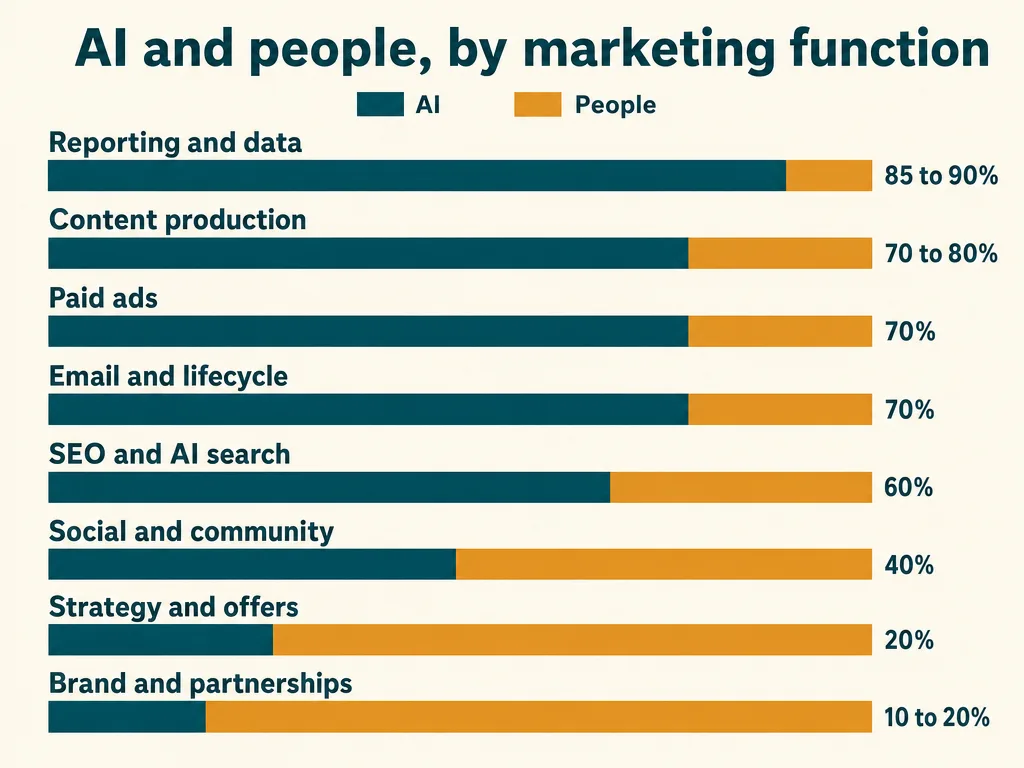
This is our working estimate of the share of hours AI could do, compared with people, in each marketing function. It is not a survey and not a measured statistic. It comes from 16+ years of building marketing teams. It assumes a team that uses current AI tools in 2027 and has a person check every output.
AI about 85 to 90 percent, people about 10 to 15 percent
- AI does
- collects numbers, builds dashboards, cleans lists and writes the first summary
- People do
- decide which numbers matter, question odd results and own the tracking setup
AI about 70 to 80 percent, people about 20 to 30 percent
- AI does
- drafts, rewrites, resizes and translates copy and produces image and video variations
- People do
- choose the angle, add real experience, edit and approve what goes out
AI about 70 percent, people about 30 percent
- AI does
- builds ad variations, adjusts bids and budgets inside set limits and reports daily results
- People do
- set the offer, the audience and the budget limits, and judge whether the numbers are true
AI about 70 percent, people about 30 percent
- AI does
- writes sequences, personalises subject lines and times the sends
- People do
- decide the journey, the promise in every message and the rules on who gets what
AI about 60 percent, people about 40 percent
- AI does
- researches keywords, drafts outlines, audits pages and checks technical issues
- People do
- choose what to rank for, supply first-hand proof and decide what is worth publishing
AI about 40 percent, people about 60 percent
- AI does
- drafts posts, schedules them and sorts comments
- People do
- hold real conversations, handle complaints and keep the tone of the brand alive
AI about 20 percent, people about 80 percent
- AI does
- gathers research, summarises competitors and tests options on paper
- People do
- choose who to serve, what to promise and what to say no to
AI about 10 to 20 percent, people about 80 to 90 percent
- AI does
- drafts briefs and keeps notes and follow-ups tidy
- People do
- build trust, negotiate, appear in person and agree the promise with sales
Added up, the overall split is about 60 to 70 percent AI and 30 to 40 percent people, as a share of hours.
How much of your team's week AI could take
Enter the hours your team spends on each function in a week. The defaults are an example five-person team at 40 hours each, 200 hours in all. The calculator takes the lower or middle value of our working estimate for each function. The calculator uses 85, 75, 70, 70, 60, 40, 20 and 15 percent for reporting, content, ads, email, SEO, social, strategy and brand. It assumes a 40-hour working week per person.
Hours per week on reporting, data and operations
Hours per week on writing, design and video
Hours per week on paid campaigns
Hours per week on email and customer journeys
Hours per week on search work
Hours per week on social posts and community
Hours per week on planning, positioning and offers
Hours per week on brand, partnerships, PR and sales alignment
Result
- Team hours a week
- 200hours
- Hours AI could take
- 116hours
- Hours that stay with people
- 84hours
- AI share of the week
- 58percent
- People needed at 40 hours a week
- 2.1people
- for the work that stays human
With the defaults, AI could take 116 hours and 84 hours stay with people. The AI share is 58 percent, and the remaining work needs about 2.1 people. It means the same team could spend its week on different work.
Why the human 30 percent matters more than the AI 70
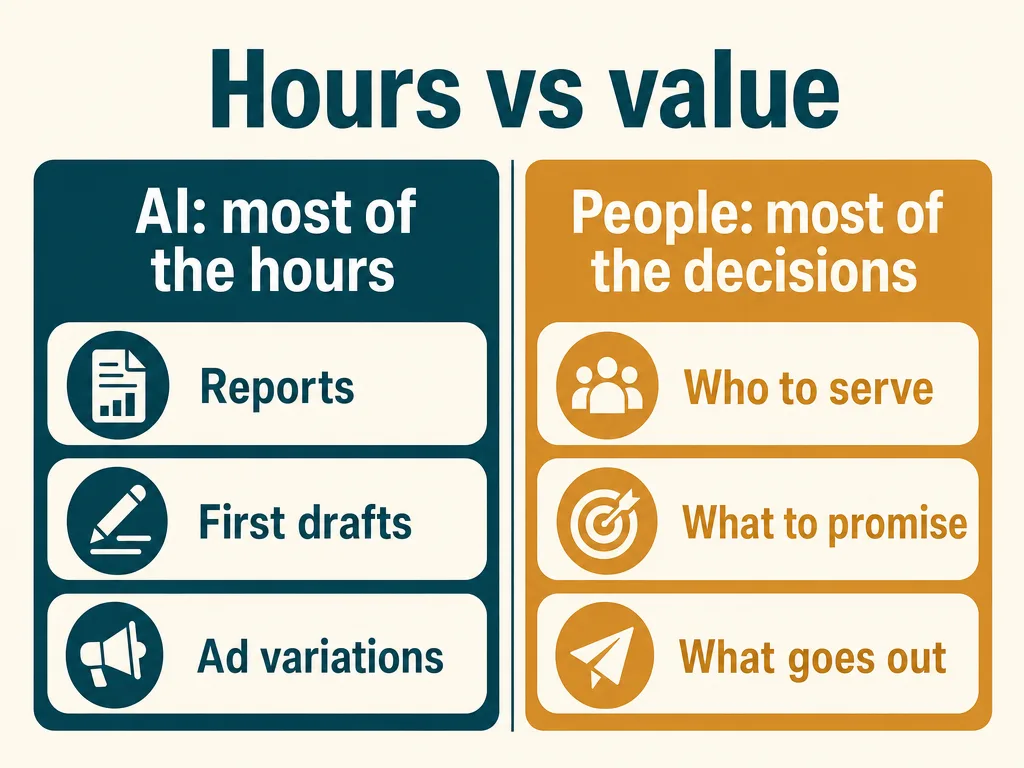
The people's share is the smaller part of the week and the larger part of the outcome. A team that counts hours sees AI winning. A team that counts decisions sees where the results come from.
Count hours
- Hours spent producingCounting pages written or reports sent rewards the work AI does cheapest. The count rises and results stay flat.
- Output per personWhen AI can draft ten versions in a minute, the number of drafts tells you nothing. Volume stops being a sign of skill.
- Tool adoptionCounting AI users says nothing about whether the right offer reached the right customer.
Count decisions
- Decisions that moved a numberOne choice of audience or offer can change a quarter. Track the decisions, who made them and what changed afterwards.
- Judgement on what goes outAI produces more than a team can publish. The person who rejects the weak versions protects the brand and the budget.
- Trust built with real peopleCustomers, partners and journalists deal with a person they can phone. AI cannot hold that relationship for you.
Track both counts for one month. Then judge the team on the decisions column, not the hours column.
What marketing jobs are safe from AI?
The safest marketing work is mostly judgement: strategy, brand, partnerships, community and the people who direct AI. No job is guaranteed, and each of these changes as AI takes the production tasks around it.
Leadership
Head of marketing or CMO
Someone must own the goals, the budget and the trade-offs, and answer for the result. AI changes the job by giving the head of marketing faster research and reports. Read what a CMO does for the full role.
Brand
Brand and positioning
Deciding what a company stands for, and what it refuses to say, is a choice made under uncertainty. AI can produce a hundred slogans. A person decides which one the company can live up to.
Relationships
Partnerships and PR
A partner signs because they trust a person. AI changes the preparation, not the handshake, the phone call or the favour returned.
Relationships
Community
Members stay for real replies from real people. AI can sort questions and draft answers, but the person who knows the members decides what to say.
Editing
Editors, not first-draft writers
First drafts are the cheapest thing AI makes. Choosing the angle, adding first-hand experience and cutting what is wrong is where the value moves.
Data
Marketing operations and data
AI builds the dashboards, but someone must own tracking, consent and the definitions behind every number. That person stays valuable as the volume of data grows.
A job title is not safe on its own; the tasks inside it matter. A person who only produces first drafts, reports or sizes sees the biggest change.

What a marketing department looks like after AI
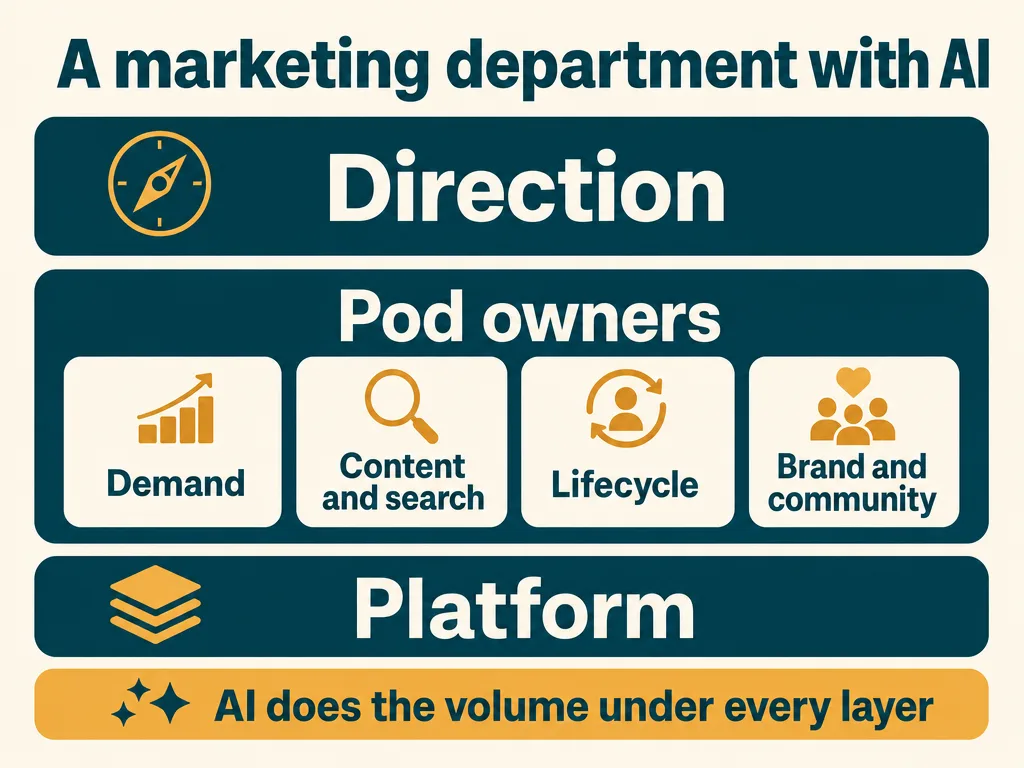
A marketing department after AI has fewer people, more senior people, and AI doing the volume under every layer. This is the structure we recommend, from advising 135+ companies and building 40+ teams.
- Layer 1
Direction
The head of marketing sets goals, picks the customer and the offer, and owns the budget. This is a part-time role in a small company and a full-time role as it grows.
- Layer 2
Pod owners
One owner each for demand, content and search, lifecycle, and brand and community. Each owner manages AI output in their area, edits it and answers for the numbers.
- Layer 3
Platform
Marketing operations and data keep tracking, consent, tools and reports in working order. AI does the volume under every layer, and people approve anything public.
Hire in this order: direction first, then editors and operators who can direct AI, then specialists where the numbers justify them. Use the AI marketing team map to see which tasks sit where, and read how to build a marketing team for the sequence.
Small teams work differently. A founder plus one generalist can run these layers with AI filling roles a small business could not hire for. The founder keeps direction and the generalist owns the pods.
Give every task a number, so AI output and human work are held to the same standard. Say six platforms, a 2,000-word post, a video of a set length. In our own videos we make this point about keeping any marketing department accountable. It works because a task with a number can be checked, whoever or whatever did it.
Where AI falls short in marketing
AI is fast, but it is wrong in ways that cost money and trust. Use this list on your own team, and tick each line that is already true.
0 of 5 done
AI cannot be accountable for a wrong claim, a data leak or a tone-deaf post. A person is. That is the main reason the human share of hours stays above zero.

How to keep your marketing job as AI takes over tasks
The World Economic Forum expects nearly 40 percent of the skills required on the job to change by 2030. It also projects that 59 of every 100 workers need reskilling or upskilling, and 11 of them are unlikely to get it. In our own videos we ask how to "become irreplaceable" in a changing job market. These five steps are how we would answer for marketing.
Move up the decision ladder
Stop competing on drafts. Take ownership of the choice of audience, offer or message.
Learn to direct AI
Write clear instructions, set limits and review the output. The WEF expects AI skills to grow fastest.
Keep the skills AI lacks
Analytical thinking, resilience, leadership and collaboration stay core, according to the WEF.
Put a number on your work
Write every task with a count or a target. Show the result in numbers each month.
Become known to real people
Build relationships with customers, partners and a community who know you by name.
None of this guarantees a job. It moves your week toward the work that AI cannot be held to account for.
How exposed is your marketing role?
Answer five questions about your own week. A higher score means more of your work is production, which is the kind AI takes first.
Answer every question first
- Mostly judgement work
Keep building it. Learn to direct AI so you can hand it the production while you keep the decisions.
- Mixed
Move time from production to editing and decisions. Pick one task AI could do this week and spend those hours on judgement work.
- Mostly production
Start using AI on your own tasks now and add one judgement skill, such as choosing audiences or editing. Begin with one task this week and check every line AI writes.
No score promises a job or a result. It shows where your week sits today.
What to do next
If you run a company, decide who owns direction, and which tasks AI does under their eye. If you want help setting that up, look at our AI and people team service, or hire the people who direct it.
If you are a marketer, run the calculator on your own week, take the quiz and pick one step from the flow. For the wider picture, read the wider guide to AI marketing.
Common questions
- Which jobs can't AI replace?
- For marketing, the human-heavy functions are the hardest to hand over. They are strategy and positioning, brand, partnerships and PR, sales alignment, and community work that depends on trust. In our working estimate, people do 80 to 90 percent of the hours in brand and partnerships and about 80 percent in strategy.
- Which 5 jobs will survive AI?
- Nobody can promise that any job survives, so treat this as a list of the most judgement-heavy marketing roles, not a prediction. Five depend most on decisions and trust: head of marketing, brand lead, partnerships and PR manager, community lead and marketing operations owner.
- Where will marketing be in 10 years?
- We do not forecast that far. The World Economic Forum's 2025 report looks to 2030. It expects 22 percent of jobs to be disrupted, nearly 40 percent of required skills to change, and a net gain of 78 million jobs. Those figures cover all jobs, so read them as a direction for marketing, not a forecast for your role.
- What will digital marketing look like in 2030?
- Expect the roles to shift more than disappear. Production work moves to AI, and people spend more time on editing, strategy, relationships and checking results. The WEF names AI, big data and cybersecurity skills as the fastest growing, with analytical thinking, resilience and leadership staying core.
- Will AI replace digital marketers?
- It will replace parts of the job before it replaces the job. A digital marketer whose week is mostly first drafts, reports and ad variations has the most to change. One who chooses the audience, checks the output and can show results in numbers has the most to gain from AI.
- Is marketing still a good career with AI?
- Yes, if you build the right skills. Marketing still needs people who can decide, persuade and be held to account. A freelancer or employee who directs AI, edits well and reports results in numbers is more useful. The production cost of the work has fallen.
Further reading
- Answer engine optimization: what actually moves the needle in SEO and AEO
The small set of work behind most of the result, drawn from what Google, Microsoft, OpenAI, Anthropic and Perplexity publish, plus this site's own numbers.
13 min read
- What does a fractional CMO cost?
Published monthly, hourly and project rates, and what a full-time CMO costs by comparison. Then the thing that actually sets the price, which is not the number of hours.
13 min read
- How to hire an SEO expert in Bangladesh
A recruiter's guide for founders and hiring managers: define the job, find the candidates, test them on your own site in thirty minutes, and pay against your own benchmark.
13 min read